

'Insubordinate'
Black boys are often disciplined for failing to fit institutions that have made too little room for how they think, move, question, and learn.

I was the kind of child who believed school had been made for me.
From kindergarten on, I would rush home eager to tell my mother what I had learned. She listened no matter how busy she was, and her attention made knowledge feel consequential. Each new word, fact, or equation seemed to bring me further into the world. I raised my hand. Teachers called on me. I was good at performing the kind of childhood that classrooms reward.
But even then, I noticed that school did not seem to have been made for everyone.
I watched classmates collapse into themselves when they could not keep up. A wrong answer could change the atmosphere around a child. Teachers became less patient. Other students laughed. The child who had been struggling with a lesson was suddenly treated as though he were the problem.
So I began translating.
I drew analogies. I repeated instructions in language my classmates understood. I explained concepts while the teacher was talking. Adults sometimes called it “talking too much” or being a distraction. But I knew that the official description of my behavior did not fully explain what I was doing.
I was trying to carry other children with me.
When I think about first grade, I think about my classmate Marcus. He lived a few blocks away from me. He was smart, sometimes faster than I was when we raced at recess, and funny in the particular way children are funny. He could flip his eyelids inside out and send the whole class into hysterics.
One day, Marcus raised his hand to answer a question. He got it wrong.
I watched him sink into his seat as Ms. Gardener moved on. He tried to make himself small. A moment later, his eyelids were inside out. The class laughed.
But I knew Marcus. I knew how smart he was. I knew that he was not clowning because he did not care. He was clowning because he was embarrassed.
While the teacher was not looking, I leaned over and repeated something my mother had told me: subtraction just means “take away.” I showed him how to draw circles, cross some of them out, and count what remained.
I still remember the look on his face when it clicked. His eyes lit up. He counted the circles that were left and found the answer.
What Marcus needed was not removal, humiliation, or a new identity as the class clown. He needed another explanation. He needed someone to imagine that he could still understand.
Long before a Black boy is removed from a middle school or high school classroom, the institution may begin removing him from its imagination. It happens as early as preschool. According to the U.S. Department of Education, Black children make up just 19 percent of preschool enrollment, but account for 47 percent of preschoolers suspended more than once.
The removal happens quietly. He taps his pencil after being told to stop. He turns a lesson into a joke. He asks why a rule exists and remains unsatisfied when the answer is simply that it does. He rocks in his chair, argues too long, laughs too loudly, or walks across the room without permission.
None of these actions is especially mysterious in a child. They may come from boredom, embarrassment, nervousness, curiosity, anger, hunger, or the ordinary misery of being young and required to sit still.
But adults begin assembling the incidents into a theory.
He is not restless. He is disruptive.
He is not frustrated. He is defiant.
He has not made a bad decision. He is becoming the kind of person who makes bad decisions.
A passing mood hardens into a temperament. A classroom interruption becomes a character flaw. Energy becomes evidence.
Every child enters school unfinished. That is supposed to be the point. Children arrive without emotional discipline, political language, good judgment, or a reliable sense of proportion. They test limits because they do not yet know where the limits are. They imitate, exaggerate, retreat, perform, and explode. Childhood is full of false starts.
But Black boys are often denied the generosity that makes those false starts survivable.
Research on the adultification of Black children proves that this phenomenon is not just anecdotal. A landmark study led by Dr. Phillip Atiba Goff found that the public perception of childhood innocence begins to drop sharply for Black boys when they are just 10 years old. In the same study, adults—including authority figures—consistently overestimated the age of Black adolescent boys by an average of four and a half years.
The practical consequence is not difficult to understand. When a child is seen as half a decade older than he is, his behavior appears more deliberate. His anger looks more menacing. His size matters more. His mistakes begin to seem like choices made with adult knowledge and adult intent.
The twelve-year-old becomes, in the adult imagination, a small man who should have known better. Once adults believe they know what kind of child they are dealing with, they begin noticing everything that confirms it.
Research on teacher discipline has also suggested that racial disparities may intensify after repeated minor offenses. A first infraction may be treated as an isolated incident. After another, however, a Black student is more likely to be interpreted as displaying a pattern. He is becoming a troublemaker. Similar behavior from a white student is more likely to remain an event: a mistake, a phase, a bad day.
The Black child accumulates an identity. The white child accumulates incidents.
From there, the process can sustain itself. The child labeled difficult is watched more closely. Because he is watched more closely, more of his behavior is observed. Because more is observed, more is corrected and recorded. The expanding record then appears to justify the original suspicion.
The institution creates evidence for the conclusion it had already reached.
On a national scale, that evidence becomes a pipeline. Though Black students account for roughly 15 percent of public school enrollment, federal data shows they endure nearly 40 percent of all out-of-school suspensions. And the disparities hold regardless of class: even in the nation’s most affluent school districts, Black boys are suspended at more than four times the rate of their white peers.
Its paperwork appears objective: dates, infractions, referrals, suspensions. Yet beneath the clean administrative language is an act of interpretation. Someone has decided what each behavior means, and those decisions have steep consequences. Federal civil rights data reveals that for the exact same categories of behavior, Black students are 2.3 times more likely to be referred to law enforcement than white students.
“Insubordinate” does not merely describe a child who refused an instruction. It implies an attitude toward authority.
“Disruptive” does not simply mean that learning was interrupted. It suggests that disruption belongs to the child.
“Dangerous” reaches further still. It transforms a possibility into an identity and an identity into a forecast.
Once these words attach themselves to a boy, adults stop encountering him in the present. They begin responding to the future they fear he represents.
Marcus’s flipped eyelids could have been interpreted as evidence that he did not care about learning. Had the behavior continued, it might have become evidence that he was disruptive, immature, or unwilling to take school seriously.
But I had seen the moment before the performance. I had watched embarrassment become comedy.
The clowning was real. So was the pain beneath it.
Schools, of course, need order. A teacher cannot educate thirty children in a room where no one respects boundaries. Children require correction. They need to learn that frustration does not excuse cruelty, that charisma is not permission to dominate, and that anger must not become harm.
But correction is not the same as condemnation. Structure is not the same as exclusion. A boundary should tell a child where he must stop, not where adults have stopped imagining he can go.
American classrooms tend to reward a particular performance of childhood: sit down, face forward, wait your turn, soften your disagreement, and keep your body contained.
Some children learn this performance easily. Others do not. They think while moving. They discover through argument. They turn humor into social currency. They test the strength of an adult’s authority before agreeing to trust it.
These qualities can exhaust a teacher. They can also conceal forms of intelligence that schools are poorly designed to recognize.
The child who debates every instruction may have a fierce sense of logic. The child who entertains the room may understand people better than he understands fractions. The child who resists weak authority may be unusually alert to hypocrisy. The child who refuses repetitive work may be bored rather than incapable. The child who cannot stop moving may need a form of learning that uses his body rather than treating it as contraband.
The child whispering to a classmate during a lesson may be disrupting the teacher. He may also be translating the material for someone the lesson has failed to reach.
None of this means that every disruption is secretly a gift. Sometimes a child is simply being disruptive. Sometimes the joke is cruel, the anger misplaced, the refusal selfish.
Black boys should not have to be hidden geniuses to deserve patience. They should not have to become entrepreneurs, artists, athletes, journalists, or political leaders to prove that excluding them was a mistake.
Their childhood should be enough.
For some children, adults imagine development. They search for the right teacher, the harder class, the sport, the club, the mentor, the diagnosis, or the outlet. Their misconduct becomes a puzzle to solve.
For the assertive Black boy, the institutional imagination often narrows to management: How do we calm him? How do we contain him? How do we remove him before he interferes with everyone else?
The question is no longer what he needs in order to grow. The question becomes how everyone else can be protected from him.
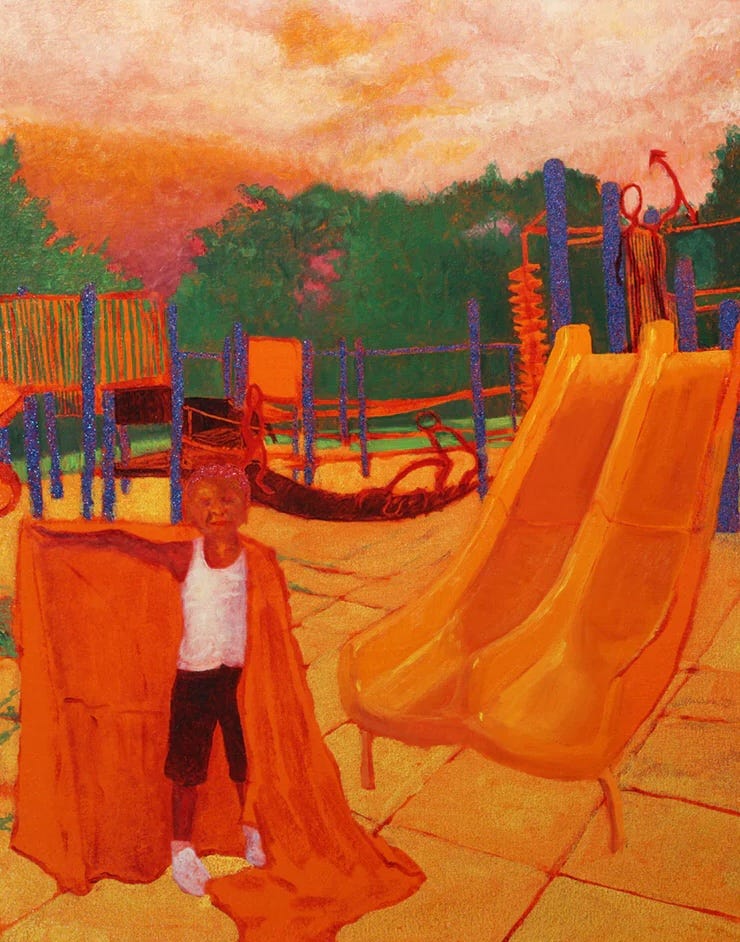
A child who believes he has been cast as the problem may eventually accept the role, or at least discover that there is little reward for resisting it. He may begin performing the toughness adults already attribute to him. He may withdraw before he can be rejected. He may turn humiliation into comedy, indifference, or rage.
What looks like proof that the institution was right may instead be the child adapting to the identity the institution made available.
That child may need to change. The institution may need to change too.
We spend enormous energy asking how to prepare Black boys for society as it exists.
Sit still.
Lower your voice.
Do not appear angry.
Do not question the wrong person in the wrong tone.
Make yourself legible to authority.
Learn the rules quickly, because you may receive fewer chances to misunderstand them.
Some of this instruction is offered as protection. Black families know the danger of a world that can interpret a boy’s confidence as threat. But a society cannot call itself free when its primary lesson to certain children is how to become less alarming to the people with power over them.
The assertive Black boy does need guidance. He needs adults who will teach him that power without responsibility can wound people, that courage without judgment can become recklessness, and that resistance must be disciplined if it is going to accomplish anything.
But he also needs adults capable of recognizing that compliance is not the highest form of human development.
Societies change because someone finds the existing arrangement intolerable. Someone asks the impolite question. Someone refuses the inherited answer. Someone moves before permission is granted.
The qualities that trouble a classroom can, when shaped rather than crushed, become the qualities that trouble a nation’s conscience.
That early experience with Marcus helped determine the work I would later choose. Journalism and education both begin, at their best, with the conviction that people deserve to understand and be understood. Both require translation: finding the language, context, or story that allows someone to see what an institution has obscured.
They also require us to question official descriptions.
The record may say that a child was disruptive. The fuller story may be that he was ashamed.
The record may say that he refused to participate. The fuller story may be that he had stopped believing participation was safe.
The record may say that he could not learn. The fuller story may be that no one had found a way to teach him.
What I learned beside Marcus was not that I was smarter than he was. I learned that understanding can depend on whether someone is willing to try another explanation. I learned that a child can appear to reject a classroom when he is actually trying to protect himself from the pain of being rejected by it.
Most of all, I learned that I did not have to choose between my own progress and another child’s possibility. I could carry someone with me.
That is the work schools must recover.
The goal is not to leave a Black boy uncorrected. It is to correct him without reducing him. To give his energy form without teaching him to be ashamed of possessing it. To hold him responsible while leaving his future open.
Before an institution decides that a Black boy is too difficult to teach, it should ask a harder question: What has it refused to learn from him?
Donovan X. Ramsey’s writing explores identity, culture, and power in America. He is the author of When Crack Was King: A People’s History of a Misunderstood Era and Had Happened, a weekly newsletter. His reporting and commentary have appeared in The Atlantic, GQ, The New York Times, and beyond.
A great read!
I think about my 18 month old son while reading this. He is strong and persistent, and my fear is already there: will the world see his big emotions as a threat?
Having brothers, I know how fast they are viewed as grown men. As parents our daily practice is to make more room for them to just grow.